Artisans of an Institute without borders, united by the same spirit
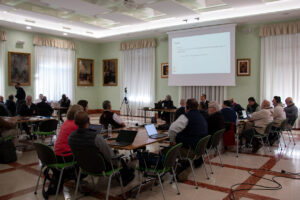 “Let us imagine together what the Institute can be (…), not limited by geography, language, or culture but united in one heart, one mind, one spirit”. With this invitation, Brother Armin Luistro, Superior General of the Brothers of the Christian Schools, concluded his remarks during the third Cluster Visit that took place at the Generalate in Rome between 16 and 20 February, with the participation of more than 30 Brothers and Lasallian lay Lasallian Partners who exercise their leadership in various Districts.
“This has been a process that has brought together Districts from across the Institute in three different groupings – between 2025 and 2026 – allowing the beautiful experience of sharing the diverse contexts, the diverse realities that we come from, seeking to connect the mission at all levels”, explains Brother Chris Patiño, General Councillor, commenting that these meetings have allowed us to “bring together those voices in smaller groups that allow us to highlight the richness of our Institute, as well as the challenges, recognising that no one walks alone”.
“New wineskins”
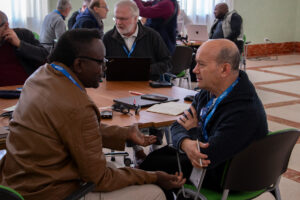 Indeed, these visits – inspired by the tradition of ad limina visits made by Catholic bishops from time to time in small groups, fostering unity and communion with the Bishop of Rome – are an opportunity to “engage in productive dialogue on key issues – both perennial and emerging – so that we can deepen our experience of 1LaSalle”, declares Brother Armin, insisting on the importance of weaving “new wineskins for the Institute”, since “we need new organisational structures that could bring about profound change and shape our collective journey forward”.
This perspective involves recognising that “our governance responsibility cannot be limited only to the efficient operational administration of my designed area of responsibility”, since “the synodal experience of listening deeply, discerning communally and acting in a concerted manner” can help us today to “widen our awareness and sensitivity to the issues faced by other Districts, especially with respect to challenges that may initially seem too alien to own experience”, asserts Brother Superior General, emphasising that “advancing the Lasallian Mission today may require leveraging the global reach of the Institute”, since “each District brings wisdom, context and best practices”.
Synodal leadership
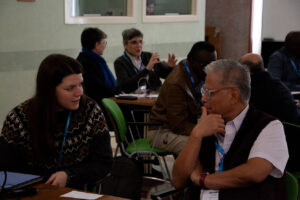 “A synodal style of leadership is about listening, fostering participation and putting into practice what we call ‘Ecclesial discernment for mission’”, Sister Nathalie Becquart, XMCJ, Under-Secretary of the General Secretariat of the Synod, had explained in her presentation during the second day of the Cluster Visit, adding that “it is about letting the Holy Spirit be the true leader and discerning our decisions through this mutual listening and processes of discernment in common”.
“So, it is a way of exercising authority in which we do not decide alone, because we are enriched by different perspectives to understand a situation”, Sister Nathalie continued. “So, it is a collaborative leadership, a discerning leadership and, we can say, servant leadership”.
In the words of Brother Carlos Gómez, Vicar General, “in an Institute that embraces synodality, leadership is renewed and rethought; it involves decentralisation, communal discernment and shared responsibility”. Thus, he emphasises, “it listens first, prays before deciding, includes rather than marginalises, and listens to voices that dissent or question”. Certainly, “not infrequently, truth is found on the margins and not in the centres of power, nor is it the monopoly of the wise, the old, or those who hold power”.
Active hope
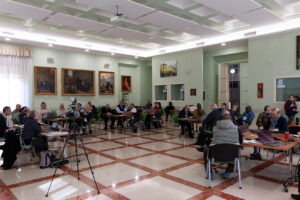 In addition to leadership and synodality, Brother Carlos refers to hope, “that elusive virtue that must become the driving force, the propellant and the inspiration of our mission”. “Hope is an indomitable force of the Spirit that impels us to live God’s plan and the generous dedication of the vocation to which God calls us”, explains the Vicar General, adding that “it implies commitment, serenity, a profound gaze, the ability to spread life, to heal pain, to dream of horizons and walk with others, to ask ourselves again who we are and what we consecrate ourselves to, what our motivations are, who are the driving forces in our lives. It is, therefore, a question of active hope and not naive optimism”.
As artisans of an Institute that is built “from within, from below, from close by”, beyond borders, with participatory and inclusive dynamics, the experience of the Cluster Visit glimpses new horizons of governance based on hope, leadership, and synodality, where “everyone has something to learn and something to teach”. Because synodality is a way of “being Church” and also a way of “being Institute” that involves decentralisation, community discernment and co-responsibility, generating processes of transformation in the Districts and Regions, under the conviction that we are 1La Salle: “one heart, one mind, one spirit”, as Brother Armin has postulated.
“I think we are really seeing new ways to operate, new ways to understand each other and new ways to support the mission around the world”, said Tom Southard, Executive Director of RELAN, as he took stock of the meeting. For his part, Brother Moses Abunya, Auxiliary Visitor of the Lwanga District, is convinced that “mutual accompaniment” is essential in order to walk together, “because no one is a custodian of knowledge and wisdom by himself”. This also implies, according to Brother Olavo Dalvit, Visitor of the Brazil-Chile District, taking on new commitments in relation to the Association of Brothers and lay people for the mission, addressing the issue of formation, where “the Districts, in each community, and as an Institute, we need to take even more concrete steps and initiatives”. Consequently, we cannot lose sight of “our identity as Brothers and our role at this historic moment”, concludes Brother Olavo, recalling that “we are Brothers for the world, as Brother Armin always says”.