“Gli educatori che sognava” (The Educators He Dreamed Of), a new book by Br. Mario Chiarapini
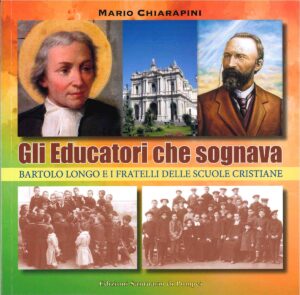 Among the literature dedicated to the figure of Saint Bartolo Longo, Br. Mario Chiarapini’s book, ‘Gli educatori che sognava’* (The Educators He Dreamed Of), i.e. the Brothers of the Christian Schools tenaciously desired by Longo in his charitable work, carves out a space of particular historical and pedagogical interest.
The author, himself a member of the Brothers of the Christian Schools, professor of Literature and expert on youth issues, guides us in the discovery of a crucial aspect of Longo’s work in Pompeii: the genesis and development of the Hospice for the Children of Prisoners.
Lasallians in Pompeii
The heart of the volume revolves around an educational challenge that, at the end of the 19th century, seemed almost insane. In an era dominated by positivist theories, which saw the children of criminals as predestined to delinquency due to “atavistic inheritance”, Bartolo Longo and the followers of St. John Baptist de La Salle opposed the revolutionary logic of the Gospel. Brother Mario masterfully highlights how this book is not only a historical chronicle, but also the testimony of a cultural battle won: where the science of the time saw irredeemable cases, Bartolo Longo saw souls to be saved through love and a healthy environment.
The title of the work is evocative and refers to the almost heroic tenacity of the founder of New Pompeii. Through a careful study of the correspondence, the author reconstructs the fifteen years of intense negotiations that were necessary to bring the Lasallians to Pompeii. It is clear that for Bartolo Longo the Brothers were not one option among many, but the only possible choice. After attempts with the Dominicans and the Piarists – solutions that Longo always considered temporary – his “dream” only came true in 1907, thanks in part to the direct intervention of Pope Pius X.
The pedagogy of Presence
One of the strengths of the book is its description of the educational method that fascinated Bartolo Longo: the pedagogy of presence. Chiarapini, thanks to his sensitivity as an educator and poet, describes touching scenes of daily life in which the religious did not limit themselves to teaching, but lived with the children, sharing games, meals and prayer. It is the “key to success” that made it possible to disprove social determinism and which received international recognition, as evidenced by the Proceedings of the Penitentiary Congress of Paris cited in the text.
Mario Chiarapini gives us a valuable, well-documented but readable work that goes beyond simple hagiography. ‘Gli educatori che sognava’ (The Educators He Dreamed Of) is the story of a spiritual friendship and deep esteem between a visionary layman and a religious congregation. It is recommended reading not only for those devoted to the history of the Sanctuary of Pompeii, but for anyone involved in education, to remember that – as Longo and the Brothers demonstrated – ‘only those who love are capable of educating’.
* Fr. Mario Chiarapini, Gli educatori che sognava – Bartolo Longo e i Fratelli delle Scuole Cristiane (The Educators He Dreamed Of), Edizioni Santuario di Pompei, 2026.
** Article written by Giuseppe S. The book is available in Italian at the bookshop of the Sanctuary of Pompeii.