La Salle, an educational charism that continues to educate “from heart to heart”
 Every 15 May, the Lasallian Family celebrates the feast of Saint John Baptist de La Salle, patron saint of educators, whose spiritual and pedagogical legacy continues to inspire thousands of educational communities around the world. Although the liturgical memorial of the French saint is commemorated on 7 April — the date of his death in 1719 — the Brothers of the Christian Schools traditionally move the celebration to May, a more suitable time to share it with students, teachers and families.
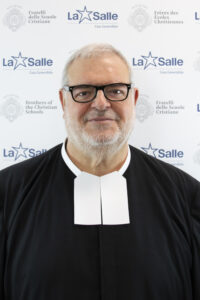
“15 May also holds special significance because on that day in 1950, Pius XII declared Saint John Baptist de La Salle the Patron Saint of Christian educators,” explains Brother Josean Villalabeitia, Postulator General of the Institute, in an interview with Vatican Radio – Vatican News.
A leading figure in modern education
More than three centuries after the founding of the Brothers of the Christian Schools, De La Salle’s legacy remains remarkably relevant today. He is recognised not only within the Church, but also in educational and academic circles as one of the great reformers of modern education.
“There is no faculty of pedagogy or education that seriously explores these issues without referring to John Baptist de La Salle,” states Brother Josean, emphasising the relevance of his educational approach, particularly for having placed young people and those most in need at the heart of the educational process.
Among the French saint’s most innovative ideas was the use of the vernacular—French—rather than Latin in the classroom, a decision that at the time provoked criticism and resistance. However, the results achieved by his schools ultimately established a pedagogical model that would profoundly shape contemporary education.
The educational mission of the laity
Brother Josean also highlights another distinctive feature of the Lasallian charism: the trust placed in the laity as key players in the Church’s educational mission.
“De La Salle stated that the world of education needs a man of integrity,” he recalls, stressing how the Founder understood the importance of educators who are fully committed to supporting young people.
As he explains, the papal Bull of Approbation for the Institute, published in 1725, is regarded by specialists as the first papal document to explicitly entrust lay people with a specific apostolic mission within the Church: school catechesis.
A path of holiness that continues
The Institute currently counts 14 saints—including ten martyrs—and 153 blessed, as well as nine venerable ones whose heroic virtues have already been officially recognised by the Church. The General Postulation continues to support various causes for beatification and canonisation in different parts of the world.
“It is an ongoing endeavour,” comments the Postulator General, noting that Lasallian holiness continues to be manifested in the quiet, daily witness of those who live out their educational vocation with dedication and fidelity.
Educating in a spirit of fraternity and closeness
The feast of Saint John Baptist de La Salle is celebrated particularly in colleges, schools and educational institutions, where the community dimension plays a vital role. “There is no Lasallian who lives out their identity by acting alone,” says Brother Josean. Interiority, fraternity and the educational ministry form an inseparable part of the charism inherited from the Founder.
In a context marked by rapid cultural and technological change, the Postulator General insists that the Lasallian message remains as relevant as ever. On the one hand, he recalls the need to take the education of children and young people seriously, avoiding superficiality or decisions driven solely by passing fads. On the other, he underlines the importance of human relationships in the educational process.
“Machines can help, but they can never replace relationships between people,” he maintains. And he recalls an expression much loved by Saint John Baptist de La Salle: educating “from heart to heart”.
The Lasallian legacy today
The Founder urged teachers to treat their students “with the firmness of a father and the tenderness of a mother” – an educational approach based on closeness, care and constant support. “Never forget that you are brothers amongst yourselves and older brothers to your students,” he would repeat to the educators.