

“As we celebrate the Jubilee of Synodal Teams and Participatory Bodies, we are invited to contemplate and rediscover the mystery of the Church”, said Pope Leo XIV in his homily on October 26, highlighting that the Church “is not merely a religious institution, nor is she simply identified with hierarchies”. On the contrary, synodal structures “express what occurs within the Church, where relationships do not respond to the logic of power but to that of love”.
It has been three days of prayer, reflection, and sharing experiences around the implementation of the decisions recorded in the Final Document of the Synod on Synodality.
“On the synodal journey, hope sustains us along the delicate and arduous path of discernment and conversion”, said Cardinal Mario Grech, Secretary General of the General Secretariat of the Synod, during the first day (October 24), when an open dialogue took place between the Pope and representatives from seven geographical regions around the world, addressing various emerging issues, such as: the principle of subsidiarity; synodal conversion; overcoming the fear of implementing synodality on the part of some bishops and priests; formation for synodality; and the need for a cultural change to make equality between men and women in the Church possible.
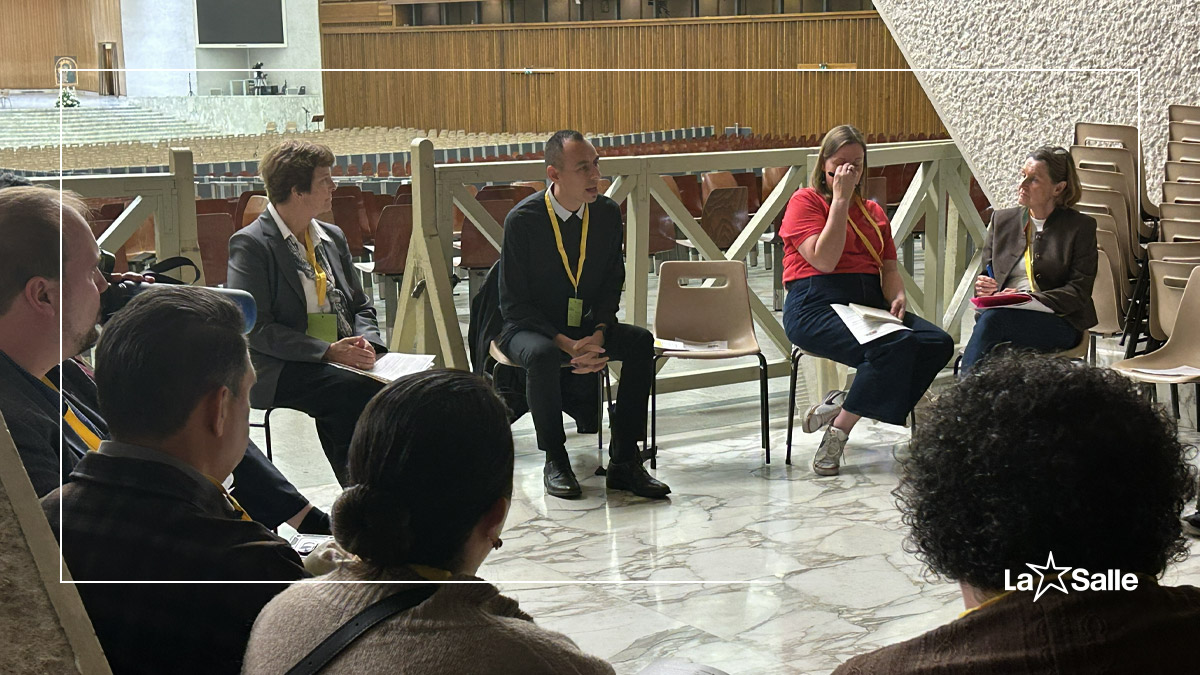
Several of these topics were also explored in depth in the 24 workshops and six seminars that were held by language groups throughout the second day of the Jubilee (October 25), where Brother Chris Patiño, General Councilor of the Institute of the Brothers of the Christian Schools, and Sister Maria Cimperman, a religious of the Sacred Heart of Jesus and coordinator of initiatives on synodality in the International Union Superiors General (UISG), led the workshop “Women and Men Together for a Synodal Church”.
Walking together as women and men
“One of the messages that we heard during the Jubilee was on unity – not uniformity – allowing for the distinct gifts of each person to be honored, to be shared, allowing ourselves to walk together as women and men”, said Brother Chris Patiño.
In this sense, Brother Chris continued, “and for us our session, our time during this Jubilee has focused on women and men walking together for a more synodal Church, and the critical formation that needs to happen for that to truly be a process, a journey of all God’s people, in an inclusive Church”.
The contribution of Brother Chris and Sister Maria during the workshop focused on “our foundational call, our foundational identity, our baptism, our common human dignity that allows us to then journey together and recognize the particular gifts that each person brings”.
At a time when it is essential to build bridges in the Church as in society, valuing the “essential identity” of the baptized and “their equal dignity as members of the people of God” can help gifts and charisms to flourish so that the Gospel message may be proclaimed and give way to increasingly just and inclusive societies and ecclesial realities.
The Lasallian contribution to the synodal Church
Taking stock, Brother Chris commented that participation in this jubilee “has been an incredible opportunity to be able to share on that message and to do so from our own experience as an Institute, as a Lasallian Family”. “We are more deeply understanding what it truly means to be synodal”.
“We are very grateful for these days that have allowed us to learn from others and from other experiences in so many parts of our world, in so many areas of the Church, and that are teaching us to be more synodal, recognizing that it is a process we are living into it and a great opportunity of the continuing walking together as God’s people”, concludes Brother Chris Patiño.