
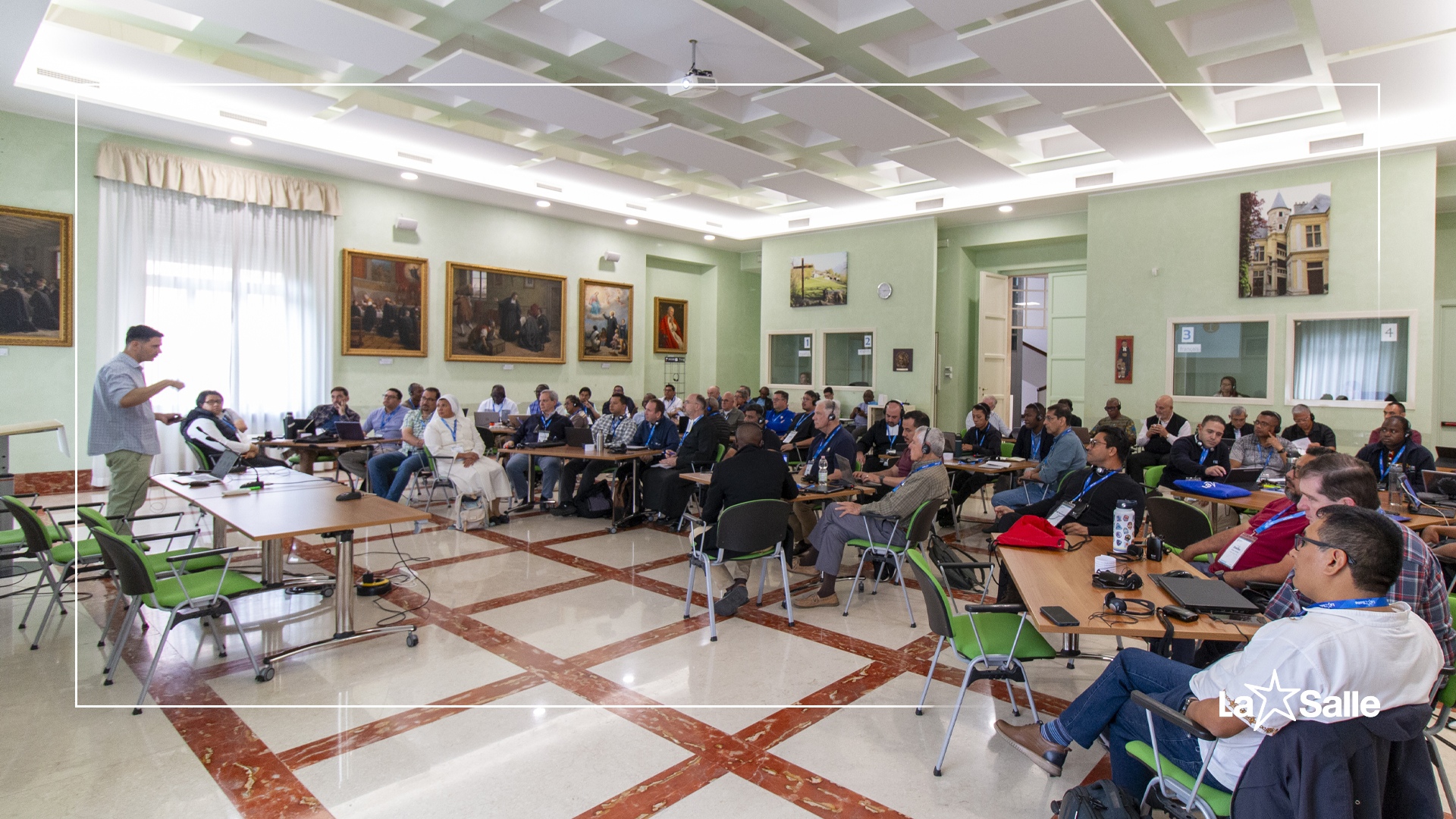


 “The Lord makes all things new”. With this statement – inspired by the Book of Revelation (21:5) – Brother Carlos Gómez Restrepo, Vicar General of the Brothers of the Christian Schools, before the 50 participants at the Gathering bringing together, between 8 and 15 May at the Generalate, Brothers involved in formation and those responsible for Pastoral Ministry of Vocations – including two Guadalupana Sisters of La Salle – from various Districts and Regions of the Institute.
Transforming hope
“To make things new does not mean erasing the past, but rather giving them new meaning and bringing them up to date, through memory and forward-looking”, emphasised Brother Carlos. It is, therefore, a matter of accepting that “Christian hope is lived out in the historical practice of transformation and the search for equity, justice, peace and care for our ‘Common Home’; that is to say, committing ourselves to the education of the poor, transforming unjust structures and anticipating, imperfectly but genuinely, that promised newness”.
“Doing all things thus becomes an act of resistance that sustains the struggle for the dreams of an Institute that is constantly renewing itself”, continued the Vicar General, urging us to look towards the horizon of a new beginning to celebrate the 350th anniversary of the Institute’s foundation – in five years’ time –, for which “the task of this Gathering is to co-create with the Lord the formation plans that will lead us to a new beginning”.
The value of experience, the responsibility of pastoral ministry of vocations, careful discernment, the global challenges of formation, and unity in the Lasallian Mission have been some of the categories proposed to carry out this work.
In a synodal spirit
“In the spirit of synodality, our formation ecosystems are called to be homes that expand, laboratories of proximity and closeness… that is the best antidote in a broken world”, proposed Sr. Gloria Liliana Franco, a Colombian religious of the Company of Mary, who participated in the recent Synod on Synodality and has presided over the Latin American Confederation of Religious (CLAR).
Sr Liliana’s address – delivered online – took place on the morning of Saturday 9 May, and focused on some perspectives for embracing synodality in the formation of the Brothers of the Christian Schools, “with our gaze fixed on Jesus and cultivating the human dimension”.
In contexts as diverse as they are challenging, “a major challenge is to form and train ourselves to live in otherness”, continued Sr Liliana, emphasising that to do so it is necessary to “nurture spaces for relationship and encounter”. This requires “becoming more capable each day of carrying out the tasks of the Kingdom ever more effectively, with boldness and creativity, from our identity as brothers and educators”, avoiding falling into the “assimilation” that “sometimes makes us mere repeaters of absurd traditions”.
The mystique of ‘us’
Originality lies “in preserving the essential”, with innovation and faithful responses, not in “sterile homogeneity”, proposed Sr. Liliana, recalling that “in a synodal Church we are not only asked to walk together, but above all to learn to come together, to work and to discern together”.
“Formation is movement”. Therefore, “the formation ecosystem is the place for encounter”, and from this perspective “synodality propels us to transcend all individualism, places us in the realm of the common good, fostering listening and enabling the expression of diversity”, asserted the Colombian nun.
“The Spirit of God continues to act and speak to the Church, and today calls out to us, inviting us to ‘walk together’. This paradigm shift, this transition from a clerical Church to a more synodal Church, will require listening and conversion, placing ourselves in the plural and developing the mystique of ‘us’”, concluded Sr. Gloria Liliana Franco.