
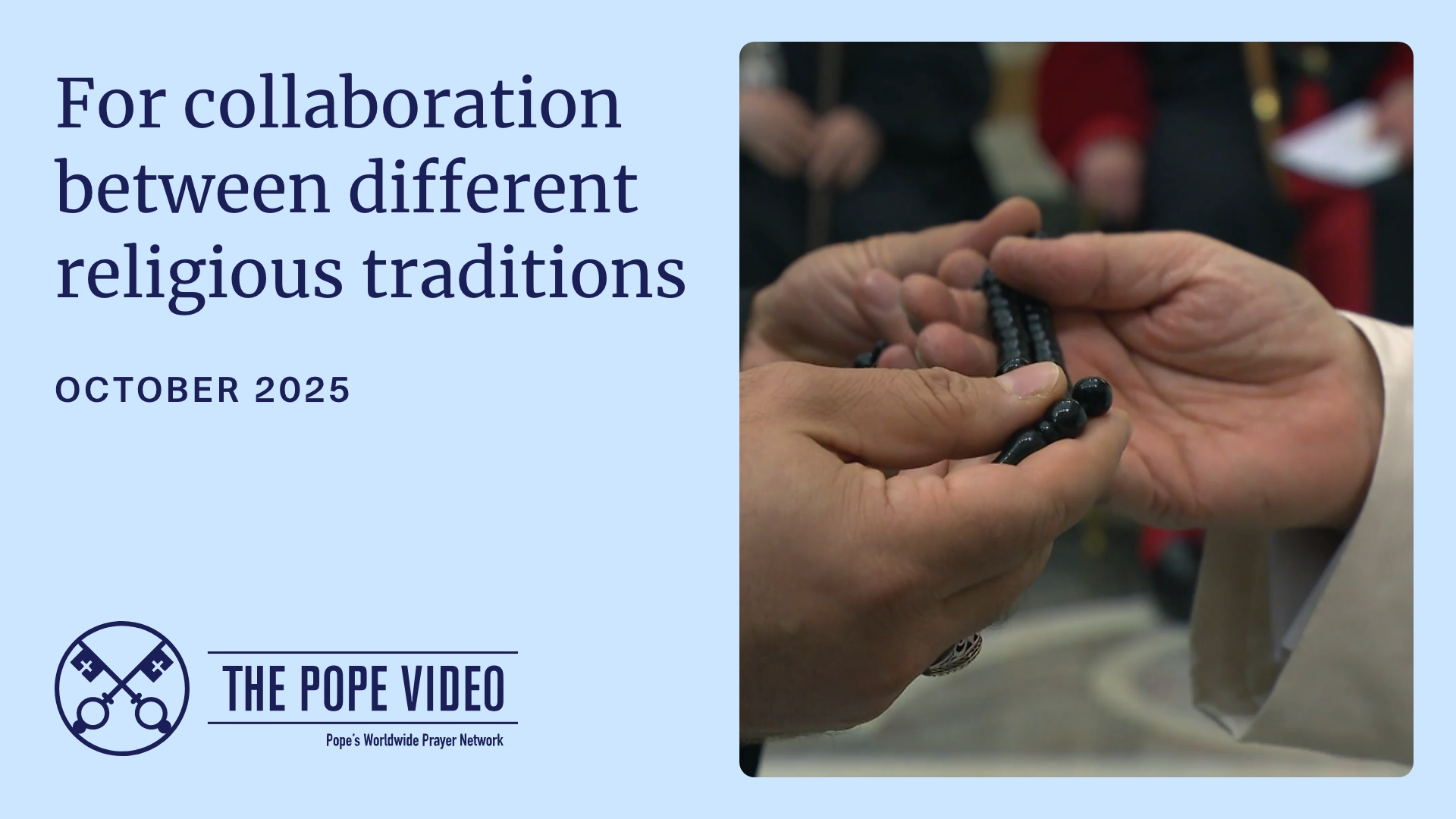


As the 60th anniversary of the conciliar document Nostra Aetate occurs during the month of October, the Pope dedicates his prayer intention to collaboration between different religious traditions.
“May religions,” Pope Leo XIV says, “not be used as weapons or walls, but rather lived as bridges and prophecy.”
“Let us pray that believers in different religious traditions might work together to defend and promote peace, justice and human fraternity.” His intention, which the Pope entrusts once again this month to the Pope’s Worldwide Prayer Network is proposed at a time marked by conflicts and polarization in which religions sometimes bow to the logic of opposition. The Pope invites us instead to rediscover in religion a bridge of fraternity and a reconciling force.
Not weapons or walls, but bridges and prophecy
The profound meaning of the prayer read by Pope Leo XIV is that collaboration among believers not be relegated to theologians and experts, but nourished by concrete and daily commitment involving every one of us. In fact, the Pope prays that we might learn “to recognize ourselves as brothers and sisters, called to live, pray, work, and dream together.” He also invokes the Spirit that “we might recognize what unites us” and “collaborate without destroying.” The different religious traditions are called to be “the yeast of unity in a fragmented world.” He continues, recalling that the contrary is often the case: “instead of uniting us, is become a cause of confrontation.”
Hence, his invitation is extended to all believers, Christians and non-Christians. He exhorts, “May religions not be used as weapons or walls, but rather lived as bridges and prophecy,” and then continues, citing “concrete examples of peace, justice and fraternity” already present.
From above and below
The Video recounts various concrete examples that intertwine with moments “from above” and initiatives “from below.” On the one hand, historical milestones on the interreligious journey: the historic meeting organized by Pope John Paul II in Assisi in 1986; Pope Benedict XVI’s visit to the Synagogue in Rome in 2010; the signing of the Document on Human Fraternity in Abu Dhabi in 2019 under Pope Francis’ pontificate; up to the most recent ecumenical meetings of Pope Leo XIV in the Vatican.
On the other hand, however, this month’s prayer intention recalls that interreligious dialogue cannot be limited to meetings with leaders. This is why the images in the video highlight experiences organized on the local level or by ecclesial organizations: the interreligious meeting organized in Singapore in April 2025 by Caritas and the Archdiocese to commemorate Earth Day; or the “One Human Family” event organized by the Focolari Movement between May and June 2024. These are two recent and concrete signs of dialogue that create proximity, trust, and daily cooperation