
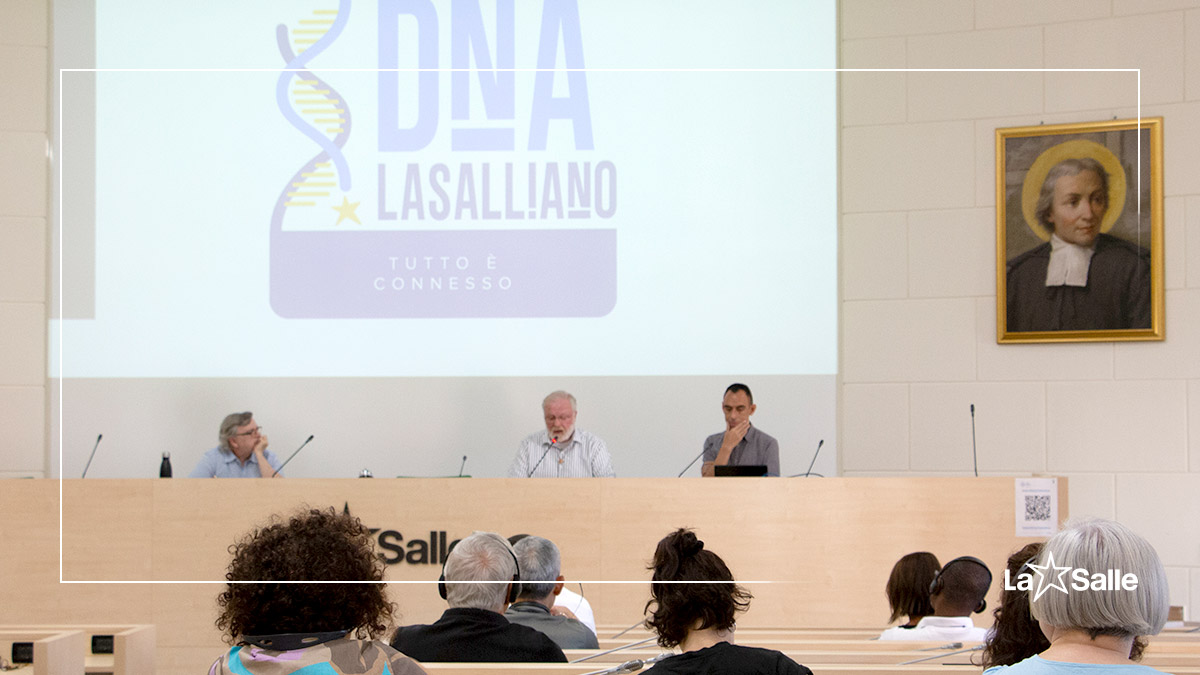


How can fraternity transform our relationships with others and with the Earth? Taking this question as their starting point, Brothers Joël Palud and Chris Patiño, General Councillors, presented some reflections on the theme proposed for Lasallian Reflection 2025-2026: “All is connected. The Community of Creation and Universal Fraternity.”
An original response
Recalling the beginnings of the Institute of the Brothers of the Christian Schools more than 300 years ago in France, Brother Chris affirmed that “fraternity is an invitation and an original response from Saint John Baptist de La Salle to the relationships of injustice of his time, which were also evident in the distress of children who lacked education and integral formation”.
Likewise, in our times, “integral ecology is not merely about recycling or carbon footprints, [but] recognises the ties that bind environment care to social justice, cultural respect, spiritual wisdom, and economic equity. It is a holistic approach that demands a transformation of systems -and of hearts” (p. 8), stated Brother Chris. Chris, author of Lasallian Reflection 11 together with Brother Joël.
Hearing the cry of the Earth and the poor
“To live 1 La Salle is to live the conviction that ‘all is connected’”, continued Brother Chris, quoting one of the texts from the Lasallian Reflection. The commitments of the 46th General Chapter call us to prophetic audacity that disrupts systemic injustices, to hear the cry of the earth and the poor, and to respond with justice, compassion and humility” (p. 9).
Becoming “living bridges” that contribute to reconnecting our fragmented world is, therefore, one of the greatest challenges for the Lasallian Family. In light of this, fraternity stands as a response to the social and environmental crises facing the world, which Pope Francis denounced in his encyclical letter Laudato si’: “We are faced not with two separate crises, one environmental and the other social, but rather with one complex crisis which is both social and environmental” (LS 139).
Hence, for Brother Joël, “fraternity, as presented in Fratelli tutti (another of Pope Francis’ encyclicals), is a response to these challenges. It invites us to recognise our interdependence and to build a human community based on solidarity, justice and respect for creation“.
Fraternity in education
For Lasallians, education is, more specifically, a point of support or “lever” for making fraternity possible, as Brother Joël has stated: “Lasallian education has always aimed to support the whole person, not only as an individual, but as a person in relation to others. Today, this means integrating fraternity and integral ecology into curricula and educational projects”.
From a practical point of view, fraternity should be seen as a call to action and conversion, suggested Brothers Chris and Joël, proposing two possible initiatives: on the one hand, changing our lifestyles to embrace simplicity, reduce our ecological footprint and prioritise human relationships could be a first step. On the other hand, it will also be necessary to take action in response to the cry of the poor and of the Earth, committing ourselves to justice and the equitable distribution of resources, as Lasallian communities do when they work in indigenous territories, rural areas or contexts of conflict where they promote peace and justice.
Daily practices of fraternity
At the end of their presentation, the authors of Lasallian Reflection 11 asserted that “fraternity is not a distant ideal, but a daily practice that begins with simple gestures: listening, sharing and working together“.
“In a world marked by fragmentation and crises, fraternity is our compass for building a more just and sustainable future“, concluded Brothers Chris and Joël, inviting the Lasallians of the Generalate to ask themselves: What does this call to integral ecology and universal fraternity mean, as well as the invitation to recognise that “all is connected” for this community of the Generalate?