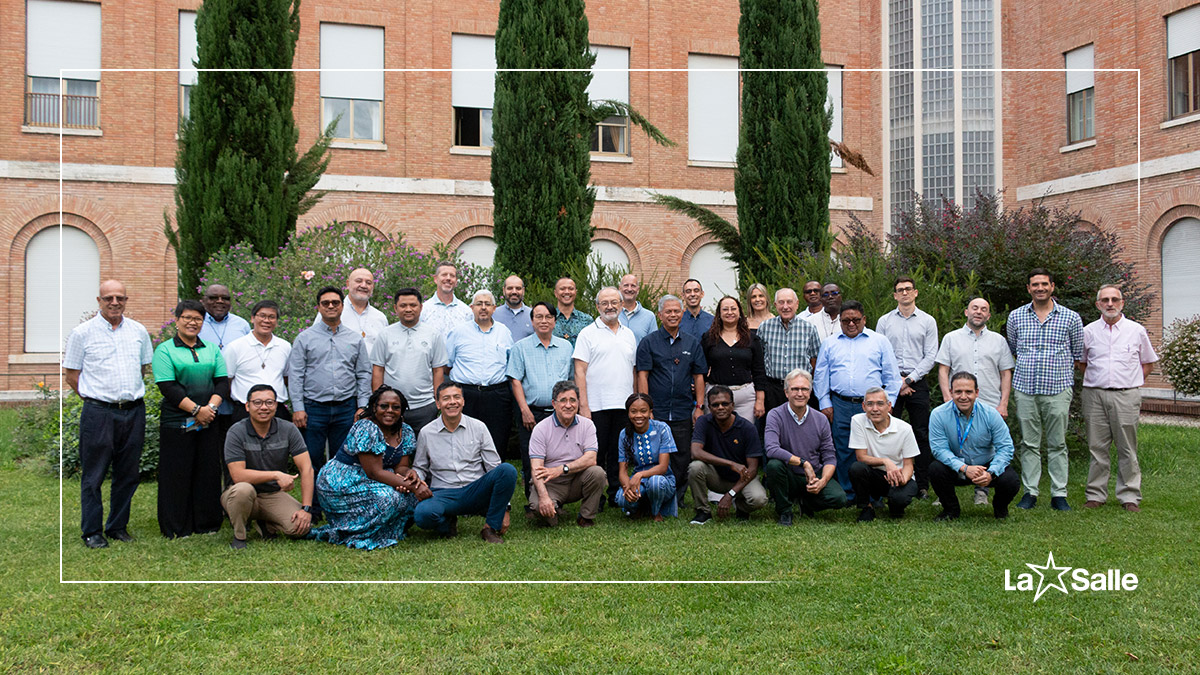


The first group visit by the Brother Visitors and some members of the leadership teams of the Lasallian Districts, held at the Generalate in Rome from 22 to 26 September 2025, marks a new milestone in the process of strengthening the governance of the Brothers of the Christian Schools in a synodal way.
In this regard, Brother Ricky Laguda, General Councillor of the Institute, explains that “one of the things we wanted to do as building a synodal path between two General Chapters is to have different moments for the District leadership teams to engage themselves with other Districts, as well as engage themselves with the General Council and the Brother Superior and the other two Councils, the Economic Council and CIAMEL (International Council for Lasallian Association and the Educational Mission).” “Therefore -continues Brother Ricky- we have created a roadmap where there is a plenary assembly every two years. The first one we had in 2024, and then in 2026, we would like to focus more on the life of the Brothers, and then in 2028, we want to look at how the Institute governance on synodality, as well as making sure that Partners are much involved in the way the decision making is being done in the way the government proceeds.”
Three group visits in 2025 and 2026
That is why “in between those Plenary Assemblies, we want to engage ourselves with the District leadership teams. So, we will have three cluster visits in 2025 and 2026, and then another one in 2027. We have 28 Districts, we divided them into three groups”.
In September 2025, the first group included the Districts of Argentina-Paraguay, DILAO (Lasallian District of West Africa), LEAD (Lasallian East Asia District), Midwest (United States), Proche Orient, Vietnam, Norandino, and the Delegation of Belgium North. The other visits will take place in December 2025 and February 2026.
“The idea is to make sure that in these cluster visits, we engage ourselves with the District leadership teams to know what is happening with them. their realities. And also for them to know what is happening with the rest of the Institute. and also so that they know what is happening with the rest of the Institute,” adds Brother Ricky.
Leadership and strategies for the future
With a participatory methodology and in an atmosphere of Lasallian spirituality and fraternity, the sessions provided opportunities for formation, sharing of experiences and community discernment around the challenges and priorities of the Institute, synodal leadership, association for mission, administration and governance, and models of governance and strategies for the future.
“It has been really inspiring,” says Joseph Gilson: “As CIAMEL, we have a lot to reflect on, we have a lot to take in and build on. And we think of the mandate of the 46th General Chapter and how it has invited us to develop this One LaSalle as a new mindset, to look at things in a new way, to think about things in a new way, and to act together in new ways.”
On the importance of moving towards One LaSalle, Brother Jose Maria Jimenez, Visitor of LEAD, believes that “one of the challenges we need to acknowledge is that we live our Lasallian commitment in different cultures and speak different languages. But given our love for the mission, I believe this is a hurdle, this is a challenge that we can all face together.”
“We are one family”
For his part, Brother Habib Zraibi, Visitor of the Proche Orient District , assures us that “the interesting thing about this meeting is that we have come together from different countries and regions. And at the same time, the Brother Visitor did not come alone: there was a whole team from each District. This puts us in an environment where, above all, we are one family, One LaSalle in the world, and at the same time, we are engaged in a process of governance, of synodal leadership: we decide as a team, together, with transparency.”
Gathering “around the table to discuss the issues of each District and find solutions” has been one of the most significant experiences, according to Brother Joseph Nguyen The Anh, from the District of Vietnam, because “during the meeting we talked about the reality of each District and also about economic issues and mutual leadership.”
“For me, the biggest take away is structural reform and spiritual renewal that we can bring to the Midwest District,” says Scott Kier, who feels challenged to “make the Lasallian Mission and the One LaSalle movement move forward in a better way.”
All in all, “it was not so much about producing texts, but about sharing experiences from which we can inspire each other to improve leadership, to make it more synodal, and to heal and make our management healthier,” says Brother Rodrigue Toeppen, Visitor of DILAO.
Synodality and spirit of community
“The topic of synodality is close to our hearts,” adds Brother Alberto Gómez, from the Delegation of Belgium North. “In fact, for me, the topic of synodality has to do with our spirit of community. Discerning as a community is part of our DNA.”
Hence, the novelty of the meeting has to do with the possibility of ” building together a new form of future governance, always within the framework of synodality with new models of leadership, but without ever losing sight of the true mission of the Lasallian District, which is to educate and work for those most in need,” according to Juan Pablo Caro, from the District of Argentina-Paraguay.
“La Salle as an opportunity to carry out our mission in all corners of the peripheries. In the company of Brothers and lay people, living our spirituality, having spaces for discernment and sharing” affirms Dianery Valencia, from the Norandino District, because “many people need you One LaSalle needs you; the peripheries need you; and we have to work together and united in association,” she concludes.