
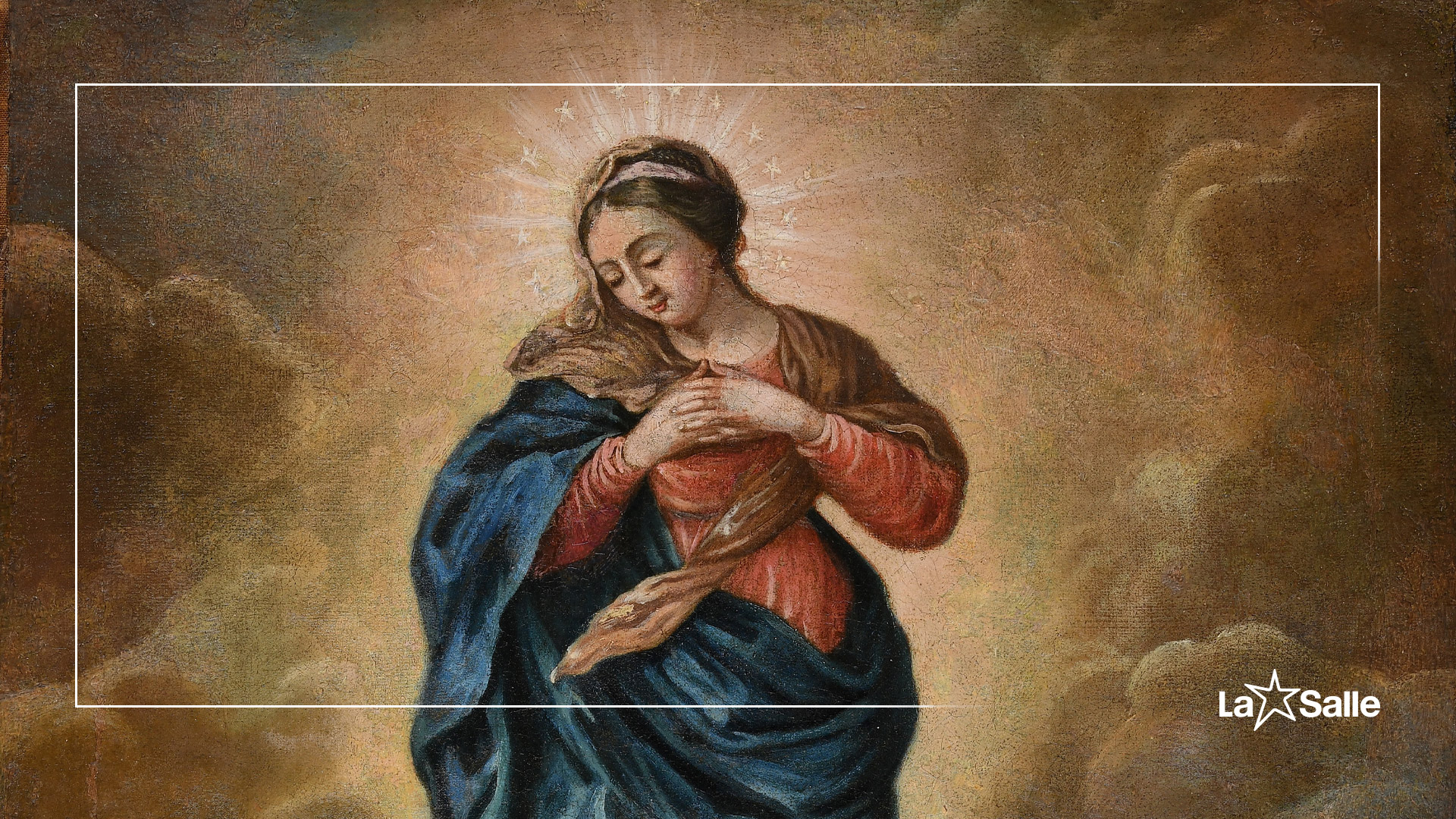


A small 18th century French masterpiece has regained its colours and history thanks to a meticulous restoration project, revealing a precious testament to art and devotion linked to the Brothers of the Christian Schools.
A small masterpiece of faith and history
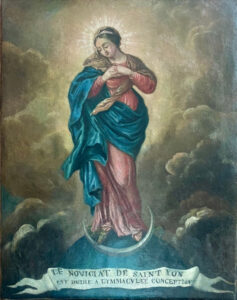 A small oil on canvas measuring 47 by 38 centimetres, originating from the historic heart of the first Novitiate of the Brothers of the Christian Schools in Saint-Yon (Rouen) and depicting the Immaculate Virgin Mary, represents a perfect fusion of 18th-century painterly skill and the spiritual heritage of the Lasallian community. The work is attributed to the 18th century French School and fits perfectly within the classical Marian iconography of Counter-Reformation art that spread throughout Europe during the 18th century.
The history preserved on the reverse of the canvas
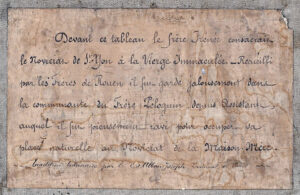 No less important than the painting itself – which captivates the eye with the grace of the Marian figure – is the reverse side, which conceals a treasure of equal significance for historians. Here, in fact, there is a handwritten inscription in French, a veritable emotional chronicle bearing witness to the extent to which this painting served as a ‘witness’ to the solemn act by which Brother Irénée consecrated the Novitiate of Saint-Yon to the Virgin. Jealously guarded first in Brother Péloguin’s community and then returned to its ‘natural home’ at the Mother House, the painting stands as a relic for the community life of the institute.
“Before this painting, Brother Irénée consecrated the novitiate of Saint-Yon to the Immaculate Virgin. Welcomed by the Brothers of Rouen, it was jealously guarded in the community of Brother Péloguin, then assistant, from whom it was devoutly removed to take its natural place in the novitiate of the Mother House”.
The iconography of the Immaculate Conception
On closer inspection of the painting, the Virgin is depicted facing the viewer, standing upright with her head gently bowed. Her hands are clasped over her chest in a gesture of deep and intimate prayer. At the figure’s feet lie the crescent moon and the globe, symbols of triumph over sin and the transience of the earthly world, whilst a golden halo shines through the clouds, encircling her illuminated head. As regards the colours and her attire, the Virgin wears a pinkish gown, draped in a wide blue-green cloak with deep, chiaroscuro folds.
The miracle of restoration: before and after
Over the centuries, natural deterioration, the build-up of dust and, above all, the alteration and oxidation of the protective varnishes had cast a dark, dull, yellowish patina over the painting. The brilliance of the fabrics, the delicate glazes of the flesh tones and the luminous contrasts of the background had been almost entirely obscured.
From a structural point of view, the textile support was stretched over an old, fixed wooden frame of crude construction, assembled with heavily oxidised iron nails that threatened to cause the canvas to come loose along the edges.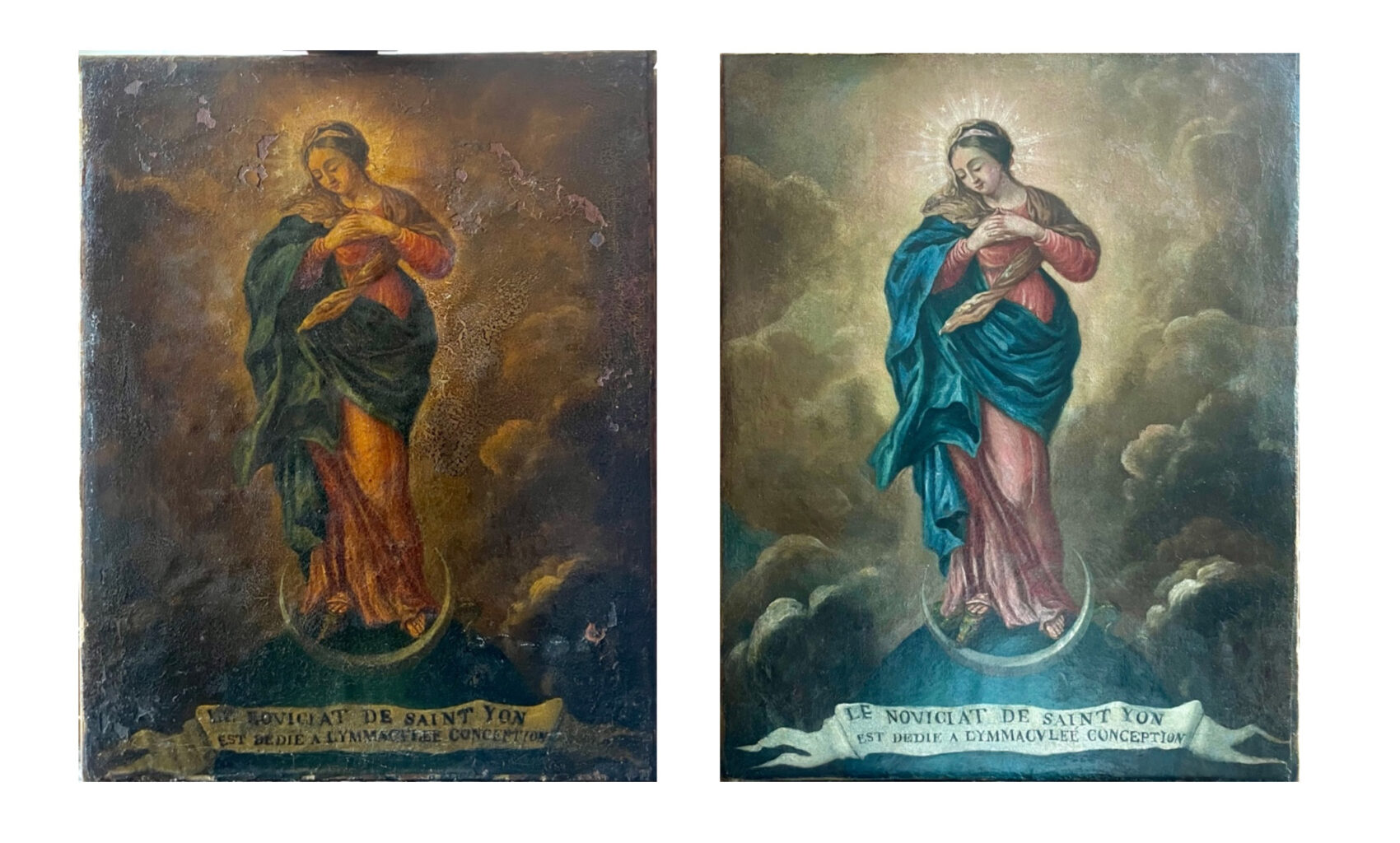
The conservation work
The restoration work was divided into several key phases:
- Stabilisation and cleaning: The delicate and gradual removal of dirt deposits and yellowed varnish allowed the surface to be ‘stripped back’, revealing the original layers of paint and the glazes used by the 18th century painter to define the skin tones.
- Revival of the colours: As evident from a comparison of the painting before and after restoration, the blue layer has regained its full three-dimensionality and saturation; the pinkish tones and the luminosity of the atmospheric background once again interact harmoniously.
- Legibility of the scroll: The lower scroll, which was previously almost illegible against the dark background, now stands out clearly, with its original inscription perfectly legible.
Conclusion: A rediscovered memory
Restoring a painting such as the Immaculate Conception of Saint-Yon does not merely mean preserving the paint layers and its wooden frame; it means reopening a window onto the past, restoring legibility to a piece of history. Thanks to this scientific and philological intervention, the canvas is no longer merely a faded memory of the 18th century, but once again becomes that living symbol of beauty, art and profound communal memory that it was for the first Lasallian novices.
The restored work will be on display at the La Salle Museum (Generalate – Rome)
* Article written in collaboration with the Office of Lasallian Heritage and Research.