The Brothers of the Christian Schools
It is necessary that the Brothers apply to themselves and take for the foundation and support of their regularity what Saint Augustine says at the beginning of his Rule: those who live in a Community ought before all else to love God and then their neighbour because these are the principal commandments given us by God and because any regularity whatever, if separated from the observance of these two commandments, is quite useless for salvation, for regularity is established in Communities only to give their members the facility to observe the commandments of God with exactness.
(Excerpt from Chapter XVI: “On Regularity,” Common Rules, 1718)
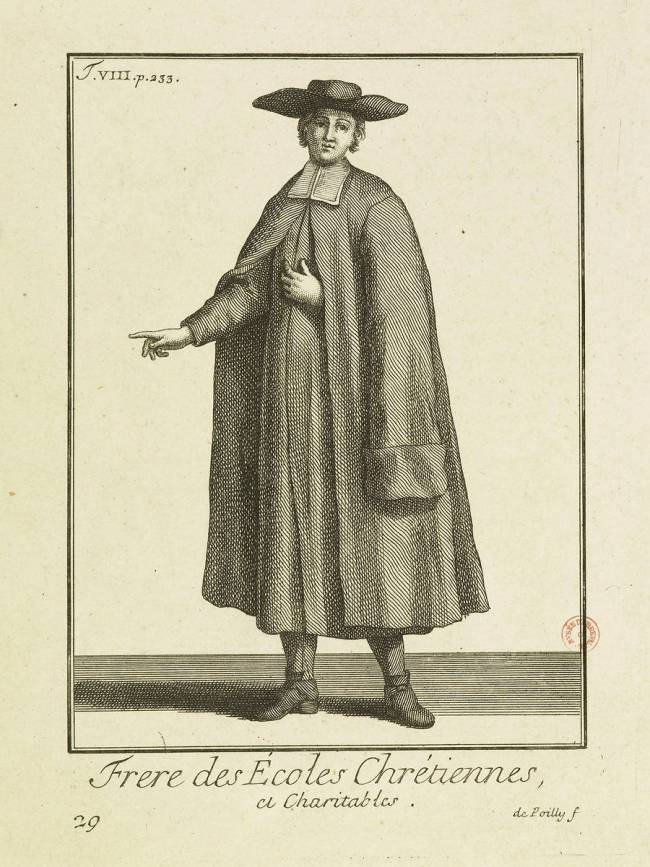 Deeply moved by the human and spiritual distress of “the children of artisans and the poor,” and in response to the call of God, John Baptist de La Salle and his first Brothers made a lifelong commitment to God to provide these children with a human and Christian education, and so to extend the glory of God on earth. They reformed the kind of schooling available at that time to make it accessible to the poor, and to offer it to all as a sign of the Reign of God and a means of salvation.
Saint John Baptist de La Salle was deeply moved by “the neglected state of the children of artisans and the poor” of his time. Soon afterwards, he became involved in helping a group of schoolteachers to establish schools to provide a good human and Christian education to poor children. The schools were named Christian Schools. Together with these teachers, De La Salle founded a community of lay people who took the name Brothers of the Christian Schools (1680).
“In their following of Jesus Christ, and in their faithful response to the calls of the Spirit and to the charism of their Founder, the Brothers consecrate themselves to God to procure his glory by fulfilling “together and by association” their apostolic ministry of education.” (Rule 2). “Christian schools, which need to be constantly renewed, are the preferred sphere of activity for the Brothers.” (Rule 3).
 “The members of this Institute live in community and call themselves Brothers. By the fraternal character of their community life and their active and disinterested presence among those they serve, they bear witness to the possibility of true brotherhood among people and nations.” (Rule 5).
“Each Brother takes upon himself the responsibility for integrating within his own person these constitutive dimensions of his vocation: consecration to God as a lay religious, the apostolic ministry of education, especially among the poor, and community life.” (Rule 12)

In responding to the Lord’s call, the Brother consecrates himself entirely to Him through the vows of association for the service of the poor through education, stability in the Institute, obedience, chastity and poverty, dedicating his entire life and all his energies to the mission of educating children and young people; in other words, to being a religious educator.

The Brother forms a community with the other members of the Institute, and all commit themselves to “conduct the Christian Schools together and by association,” especially for the service of the poor, and to carry out any mission entrusted to them, wherever they may be sent.
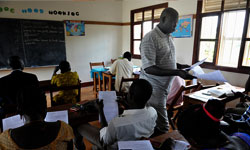 The Brother is a ‘lay religious’ and his vocation does not aim at the priesthood, because his ministry does not involve performing the sacred functions of the liturgy or administering the sacraments. The Spirit of faith, zeal and community sustains his mission to provide a human and Christian education to the children and young people entrusted to him.
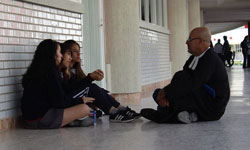
The Brother lives out his faith “as a gift received for the ministry of Christian education.” From his faith, he contemplates God who has chosen him “as a worker to bring his salvation to the very poor and lowly” (Rule 20).
 The Brother carries out his mission “with the ‘ardent zeal’ required by the Lord’s Work”. Therefore, as a “minister of God and of the Church”, he is concerned with “touching the hearts” of his students (cf. Rule 21).
 The Brother is a catechist and educator in the faith of his students. He speaks to them about God, teaches them the truths of the faith, and helps them to live their lives as Christians, leading them to the knowledge and love of God so that they may grow constantly in faith.
The Brother is an apostle who “carries out his mission as a witness, a service and a communion” (Rule 13). He always keeps in mind the promotion of justice and service to the poor “- the economically poor, the victims of social injustice, delinquents and those excluded from society – which is the preferred option of their ministry of education” (Rule 29).
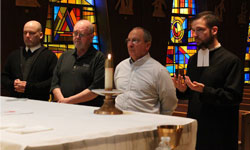 The Brother lives in union with God. Through prayer and continually nourished by the Word of God, he acquires the strength to carry out his ministry as an educator to bring students closer to God.
 The Brother is an educator by vocation. Consequently, he seeks to constantly improve himself through spiritual and professional formation, as well as ongoing study and reflection, in order to carry out his mission competently.
 Following in the footsteps of the Founder, fourteen Brothers have been canonised, one hundred and fifty have been beatified, eight have been declared venerable, and the causes of four more are in progress, some of which are nearing completion.
Related
Brothers Vocation
Resources
Photos