

Scampia is a vast working-class neighbourhood located north of Naples. Built in the 1960s and 1980s to address the housing crisis plaguing Naples, the ‘district’ became marginalised and extremely violent within a few years as the Neapolitan mafia, the Camorra, took control of the area.
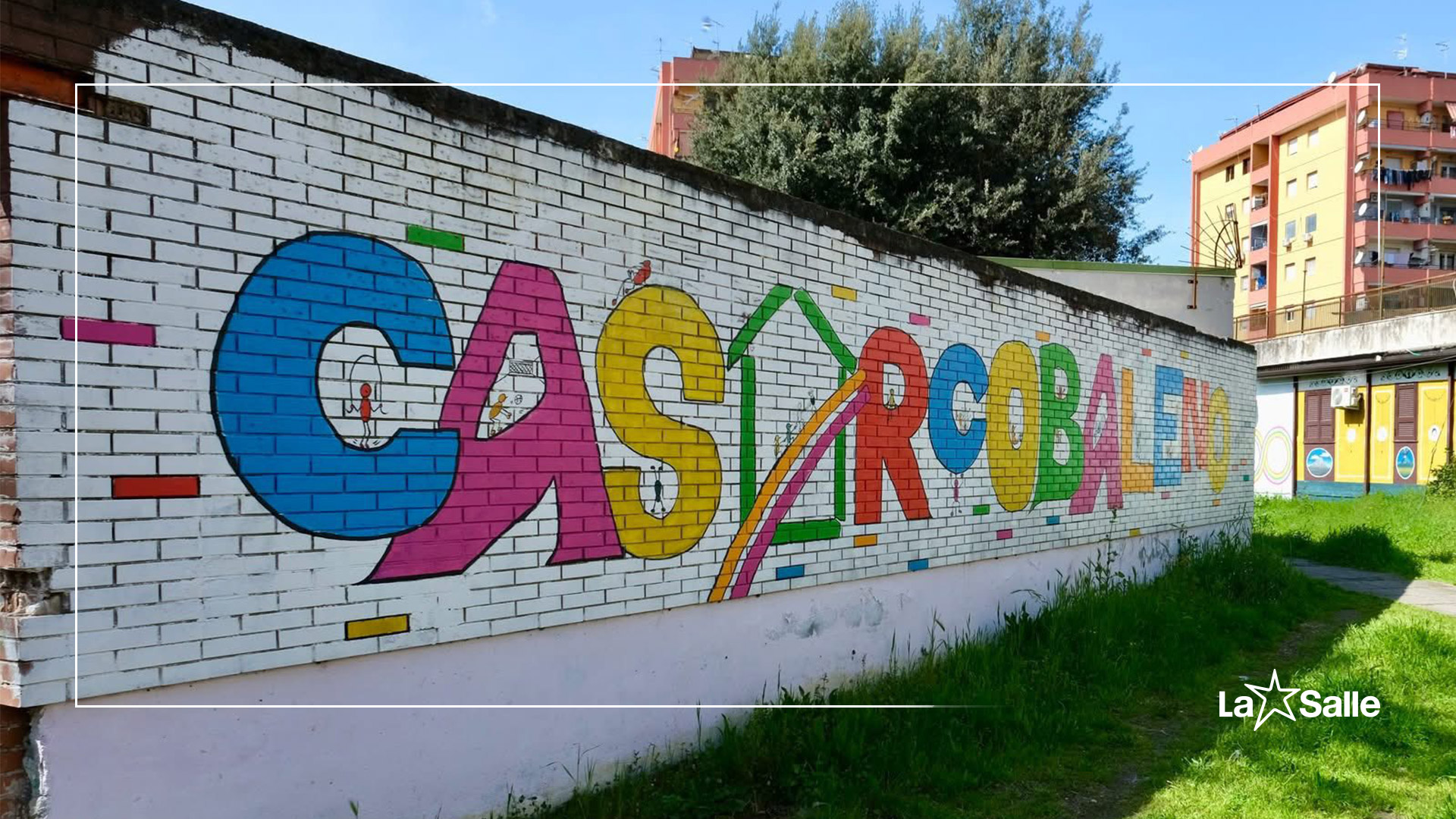
Even today, nearly 80,000 residents live in this area marked by profound inequalities, but also by numerous educational and community initiatives that are gradually seeking to transform its image into one where living together is possible. It is within this context that the educational space ‘CasArcobaleno’, ‘the house of the rainbow’, was founded.
To understand its origins, the District Chapter, which marked the amalgamation of the two Italian Districts in 2003, had chosen, among the signs of hope, to establish a community amongst the poor, in service to the beloved of the Kingdom.
After some hesitation on the part of the new Council, some Brothers began to give thought to this project with a view to bringing it to fruition; they studied statistics on school dropout rates, which proved to be a critical issue particularly in certain southern cities such as Naples, Bari and Palermo, and after making contact with various Church organisations, they submitted the results of their research to the Brother Visitor.
The choice fell on Naples, but it was the bishop who sent the Brothers to Scampia. Despite the commitment of competent teachers in state schools, support for the most vulnerable pupils remains inadequate. In this area dominated by the ‘Vele’ – those imposing blocks of flats that have become a symbol of urban decay and the Camorra’s historical stranglehold – the issue of education therefore appears to be a crucial challenge.
The Brothers of the Christian Schools, Raffaele Lievore, originally from Veneto, Enrico Muller, originally from Milan, and Martin Salvador, from the former District of Valencia-Palma, now part of the Arlep District, decided to settle there, amongst the poor, on the tenth floor of one of the neighbourhood’s skyscrapers, next to an abandoned school building that would become CasArcobaleno.
Since 2007, CasArcobaleno has thus presented itself as a ‘second-chance school’. Fifteen young people, referred solely by public schools and social services, are welcomed there every day from 9.30 am to 1.30 pm. A team now led by Pippo and supported by seven people—including teachers, educators and artists (photographers, designers, etc.)—offers personalised academic support, as well as creative activities aimed at restoring confidence and a love of learning. In the afternoon, the 15 secondary school pupils make way for around 40 local young people who take part in tutoring sessions and art workshops. The centre operates year-round thanks to funding from the Brothers of Italy district and donations; it also regularly welcomes volunteers from around the world through SEMIL (Lasallian Educational Missions Service).
Beyond its practical work, CasArcobaleno embodies the hope of social transformation through education. In Scampia, a neighbourhood often reduced to its difficulties, these initiatives bear witness to a human vitality and a desire for change that are gradually helping to rewrite its history.